
How to Become a Dog Sitter on Rover in 2026

Starting your own dog sitting business is easier than ever today thanks to platforms like Rover.
If you love spending time with animals and caring for them, becoming a dog sitter or dog walker might be one of the most enjoyable ways to earn extra money — especially if you want something flexible that gets you out of the house and away from a screen.
Dog sitting pays well, the hours are genuinely flexible, and you set your own schedule. The hard part used to be finding clients. Rover solves that problem entirely.
I’m Virginia Nakitari. I’ve been covering legitimate ways to earn money since 2017, and pet sitting on Rover is consistently one of the most underrated options in the gig economy space.
In this guide I’m walking you through everything: what Rover is, what it pays, what they require, and the exact 10-step sign-up process that gets your profile live and ready for your first booking.
💡 Earn while your Rover profile gets established — Swagbucks pays $10 just for signing up.
New members get a free $10 bonus just for creating a free account — no pets required.
👉 Claim your free $10 Swagbucks bonus →✅ Free to join ✅ $10 in your account within 24 hours ⭐ PayPal or gift cards
What Is Rover?
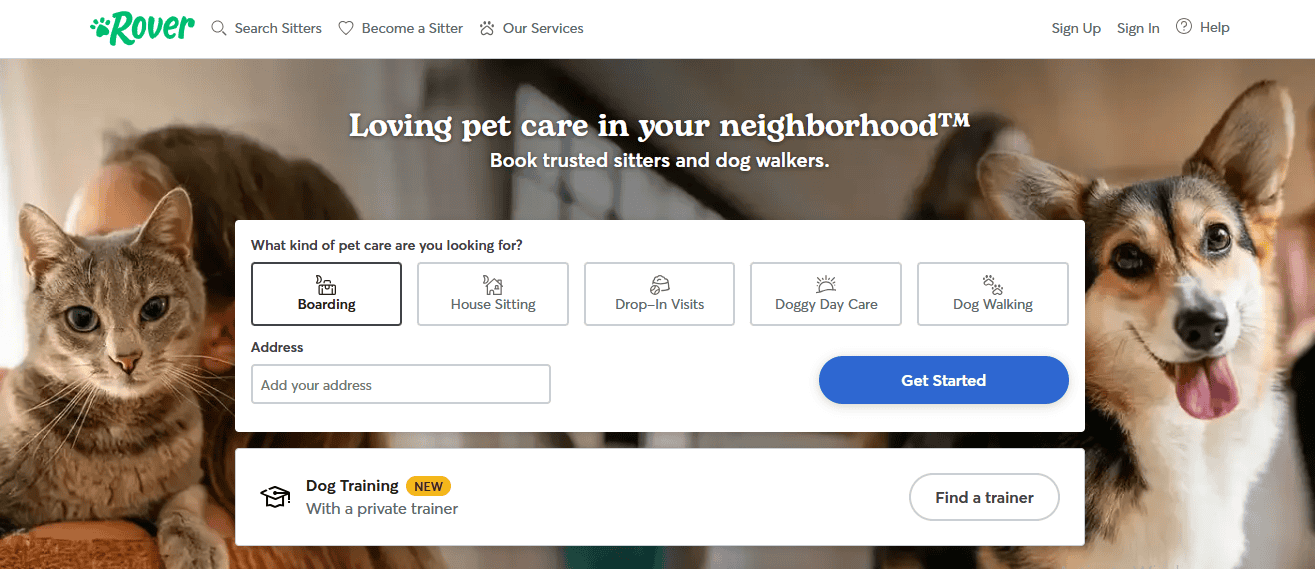
Rover is the largest pet care platform in the US — a marketplace that connects pet owners with local dog walkers, dog sitters, house sitters, and doggy daycare providers.
Think of it like Fiverr, but specifically for pet care services. Pet owners search for sitters in their area, browse profiles, read reviews, and book directly through the platform. Rover handles all the payment processing, provides $1,000,000 in insurance coverage for every booking, offers 24/7 support, and even has vet assistance available for emergencies.
For someone who loves animals, it removes the hardest parts of running your own pet care business — finding clients, managing payments, and handling the liability — and lets you focus on what you actually enjoy: spending time with dogs.
At a Glance: Rover Dog Sitting in 2026
| Feature | Details |
|---|---|
| Platform type | Pet care marketplace |
| Services you can offer | Dog boarding, house sitting, drop-in visits, dog walking, doggy daycare |
| Rover’s fee | 20% of each booking |
| Insurance | $1,000,000 per booking |
| Background check | Required |
| Minimum age | 18 years old |
| Payment method | Direct deposit, 2 business days after service |
| Realistic monthly earnings | $400–$1,500 depending on services and hours |
🎁 Free Download — First $100 Online Blueprint
Looking for more ways to earn beyond pet sitting? This free guide gives you 25 vetted platforms and a 7-day action plan to your first $100 online.
Free PDF. Instant download. No spam. Unsubscribe anytime.
Rover Pros and Cons
✅ What’s Good
You set your own schedule and prices. No employer telling you when to work or what to charge. You decide your availability, your rates, and which services to offer.
Multiple service types. You can offer dog boarding (overnight stays at your home), house sitting (staying at the client’s home), drop-in visits (checking in on pets), dog walking, or doggy daycare. The more services you offer, the more booking opportunities you get.
Rover handles the business side. Payment processing, insurance, 24/7 support, and vet assistance are all included. You don’t need to invoice clients, chase payments, or worry about liability coverage.
Genuine demand. Millions of people own dogs and regularly need pet care. There is almost certainly someone in your area who needs exactly what you’re offering.
❌ What to Watch Out For
20% platform fee. Rover takes 20% of every booking. Factor this into your pricing — if you want to net $25/night, charge $31–$32.
Competition in busy markets. In large cities, there can be many sitters competing for bookings. Strong photos, a detailed bio, and good early reviews make a significant difference.
First bookings take time. Most new sitters wait 2–4 weeks for their first request and up to a month for their first confirmed booking. A fully completed profile with photos and early testimonials speeds this up significantly.
Not available everywhere. Rover operates in the US, UK, Canada, and some European markets. Check availability in your area before applying.
Sitter Requirements
Before you apply, make sure you meet Rover’s basic requirements:
- Be at least 18 years old
- Pass a safety quiz (short online assessment)
- Complete a background check
- Provide references
- Have at least one photo of you with a dog for your profile
Rover doesn’t approve everyone who applies — they carefully screen new sitters. The background check is standard and most people pass without issues. If you have experience caring for pets in any capacity (your own, a family member’s, a friend’s), include that in your profile.
10 Steps to Become a Pet Sitter on Rover

Step 1: Sign Up to Become a Sitter
Go to rover.com and look for the “Become a Sitter” button at the top of the page. Click “Get Started” and you’ll be taken through the account creation process.
You can sign up through Facebook, Google, Apple, or your personal email address. If you use Facebook or Google, Rover will pull some basic profile information automatically to speed things up.
Step 2: Fill Out Your Basic Information and Upload a Photo
Rover will ask for your address, date of birth, email address, and a profile photo.
Your profile photo matters more than most people realise. Choose a clear, well-lit photo where you look approachable and friendly — ideally one where you’re with a dog. Pet owners are trusting you with a family member. A warm, genuine photo builds immediate trust before they’ve read a single word of your bio.
You’ll also add a phone number and emergency contact at this stage. These aren’t public on your profile — Rover keeps them for their records and uses them for urgent communication.
Step 3: Narrow Down Your Service Offerings
After your basic information is complete, Rover will ask which services you want to offer.
Your options include:
- Dog boarding — dogs stay overnight at your home (highest-earning service)
- House sitting — you stay at the client’s home
- Drop-in visits — check-ins of 20–30 minutes
- Dog walking — 30–60 minute walks
- Doggy daycare — dogs come to your home during the day
Virginia’s tip: Dog boarding and house sitting pay the most per booking. If you’re comfortable having dogs in your home overnight, prioritise these. Adding drop-in visits and dog walking as supplementary services gives you more booking opportunities while you build your review base.
Step 4: Set Your Pet Sitting Preferences
This step tells Rover — and potential clients — exactly what you can handle.
Specify:
- Dog size preferences (small, medium, large)
- Number of pets you can accommodate at once
- Whether you’re comfortable with puppies, senior dogs, or dogs needing medication
- How often you can check in or walk dogs per day
Being specific here helps Rover match you with relevant bookings and helps clients self-select. Better matching means better client fit, fewer headaches, and stronger reviews.
Step 5: Provide Information About Your Home and Pets
Rover wants to know about your living situation — whether you have a fenced yard, whether you have other pets, whether you live in an apartment or a house.
This matters because some pet owners specifically need a sitter with a fenced yard for energetic dogs, or need a home without cats for dogs that don’t do well around them. The more detailed you are, the better your profile serves as a self-filtering tool — attracting clients who are a great fit and deterring ones who aren’t.
Step 6: Craft a Catchy Bio
Your bio is where you sell yourself. Rover requires a minimum of 125 words — use them.
What to include:
- Your experience with dogs (personal pets, helping friends, any formal experience)
- What makes you genuinely good at pet care (patient, attentive, active, experienced with specific breeds)
- What a dog’s day looks like in your care — walks, playtime, sleep routines
- Why you’re passionate about animals
Be specific rather than generic. “I love dogs and will take great care of your pet” tells a client nothing. “I’ve had Labrador Retrievers my whole life, I take a 45-minute morning walk and a 30-minute evening walk every day, and your dog will sleep in the room with me” tells them everything.
Step 7: Provide Photo Proof
Rover requires at least one photo of you with a dog as part of the sign-up process.
If you have your own dog, this is straightforward. If you don’t currently have a dog, arrange a photo session with a friend or family member’s dog — even a casual walk photo works perfectly.
Add as many photos as possible to your profile. Profiles with multiple high-quality photos of sitters with happy dogs consistently convert significantly better than profiles with minimal images.
Step 8: Request Testimonials
Early testimonials are the most powerful way to establish trust with new clients — and you can collect them before you have a single Rover booking.
Reach out to anyone who has seen you with animals — friends, family, neighbours — and ask them to write a short testimonial about your reliability, your relationship with animals, or their confidence in leaving a pet with you.
No prior pet sitting experience? Volunteer to watch a friend or family member’s dog for a weekend at no charge in exchange for an honest testimonial. One real, specific testimonial is worth more than ten generic ones.
Step 9: Take the Quiz and Complete the Background Check
Near the end of the sign-up process, Rover will ask you to watch two short videos (3–5 minutes each) and answer three questions per video about pet care basics and safety.
Pay attention to the videos and the quiz is straightforward. Once you pass, you’ll agree to a background check. Every Rover sitter undergoes this — it’s standard and exists to protect both clients and their pets.
The background check typically clears within a few days.
Step 10: Set Your Calendar and Get Ready for Your First Booking
The final step is opening your calendar — marking the days and times you’re available for each service type.
Keep your calendar accurate and up to date. Pet owners searching for sitters filter by availability, and an inaccurate calendar leads to frustrated clients and cancellations that hurt your early review profile.
Once your profile is live, your first request typically arrives within 1–4 weeks. Fully completed profiles with photos, testimonials, and detailed service descriptions consistently receive bookings faster than sparse profiles.
⚡ While you wait for your first Rover booking — Swagbucks earns from today.
Survey earnings of $30–$60/month add up nicely alongside pet sitting income.
How Much Can You Realistically Earn on Rover?

Rover sitters set their own rates, so earnings vary significantly. Here’s an honest range based on 2026 market rates:
| Service | Typical Rate | Monthly Potential |
|---|---|---|
| Dog boarding (per night) | $30–$55/night | $400–$1,200 |
| House sitting (per night) | $35–$60/night | $400–$1,000 |
| Drop-in visits | $15–$25/visit | $100–$400 |
| Dog walking (30 min) | $15–$25/walk | $150–$600 |
| Doggy daycare | $25–$45/day | $300–$900 |
After Rover’s 20% fee, your actual take-home from a $40/night boarding rate is $32/night. Set your rates with this in mind.
Realistic monthly income scenarios:
A sitter offering dog boarding who watches 2 dogs per week at $40/night netting $32 after fees earns approximately $450–$500/month from boarding alone. Adding drop-in visits and dog walks on top of this pushes monthly income to $600–$800 for a sitter who is actively taking multiple service types.
Top earners on Rover in competitive markets with strong review profiles report $1,000–$1,500/month — but this represents full-time commitment across multiple services with an established reputation.
The honest expectation for a new sitter: $200–$500/month in your first 3 months while you build your review base. This increases meaningfully once you have 10–15 positive reviews and your profile ranks higher in local search.
Tips to Get Your First Rover Booking Faster
Price competitively at first. Set your rates 10–20% below established sitters in your area for your first month. Once you have 5–10 reviews, raise your rates to market level.
Respond quickly to every inquiry. Rover tracks response time and fast responders rank higher in search results. Aim to reply within an hour of any message.
Offer a meet-and-greet. Many pet owners want to meet you and see your space before committing to a booking. Offering a free 20-minute meet-and-greet removes a major decision barrier and almost always leads to a booking.
Ask for reviews after every booking. A simple message: “It was so great to have [dog’s name] with me! If you have a moment, a review on Rover would mean a lot as I’m building my profile.” Most happy clients are glad to help.
Keep your photos updated. Add new photos of dogs you care for (with client permission) regularly. An active, current profile signals to Rover’s algorithm and to potential clients that you’re actively working.
FAQ: Becoming a Dog Sitter on Rover
Is it hard to get approved as a Rover sitter?
Rover screens applicants but the process is not particularly difficult for most people. You need to be 18+, pass a background check, complete a safety quiz, and have a fully filled-out profile with at least one photo of you with a dog. The background check is the main gate — as long as you have a clean background, the rest is within your control. Having references and some animal care experience (even personal) makes the application stronger.
How long does it take to get your first Rover booking?
Most new sitters receive their first inquiry within 1–2 weeks and their first confirmed booking within 2–4 weeks of their profile going live. Sitters with fully completed profiles, multiple photos, early testimonials, and competitive pricing consistently book faster than those with sparse profiles. Patience during the first month is important — the review compound effect kicks in significantly once you have 5–10 completed bookings.
Does Rover provide insurance?
Yes — Rover provides up to $1,000,000 in insurance coverage for every booking made through the platform, plus 24/7 support and vet assistance for emergencies. This is one of Rover’s most significant advantages over finding pet sitting clients independently. The insurance coverage only applies to bookings made and paid through Rover — never accept off-platform payments.
Can I do Rover without a fenced yard?
Yes — a fenced yard is preferred by some pet owners (particularly for energetic dogs) but it’s not a requirement. Be transparent in your profile about your outdoor situation. Many sitters without fenced yards do well by emphasising their commitment to leash safety, the number of walks per day, and their experience with dogs in urban or apartment settings.
What’s the difference between Rover and Wag for sitters?
Both are legitimate pet care marketplaces with similar models. Rover is larger, has a stronger review ecosystem, and generally offers more consistent booking volume. Wag operates in more of a last-minute booking model and is more gig-worker oriented. Many sitters are active on both simultaneously to maximise their booking opportunities.
Related Posts 🐾
- 💼 Gig Economy Jobs in 2026 → — where Rover fits alongside every other major gig income stream
- 🎯 Best Ways to Make Money Online in 2026 → — the complete income strategy map
- 🚨 I Need Money Now → — fastest income options including pet sitting
- 💰 15 Jobs Where You Work 2–3 Hours a Day → — dog walking fits this model perfectly
- 📊 Side Hustles That Actually Pay → — Rover alongside every flexible income option
- 💻 12 No-Experience Work From Home Jobs → — for readers who want indoor alternatives alongside Rover
Final Thoughts: Your First Dog Sitting Client Is 30 Minutes Away 🐾
If you love animals and want flexible income that gets you away from a screen, Rover is genuinely one of the best gig platforms available. The sign-up takes 30–40 minutes. The first booking typically arrives within 2–4 weeks. And the income scales as your reviews build.
The key to getting started fast: complete your profile fully, price competitively for the first month, offer meet-and-greets, and respond quickly to every inquiry.
Your action plan today:
- ✅ Visit rover.com and click “Become a Sitter” — profile takes 30–40 minutes to complete
- ✅ Take photos with a dog — borrow a friend’s if needed, get at least 3 good shots
- ✅ Request 2–3 early testimonials — from anyone who’s seen you with animals
- ✅ Set competitive introductory rates — 10–20% below local market while you build reviews
- ✅ Earn while you wait for your first booking →
- ✅ Read the full gig economy jobs guide →
Are you already a Rover sitter, or are you thinking about signing up? Drop a comment below — I’d love to hear about your experience or answer any questions before you get started!
Disclosure: This post contains affiliate links. If you sign up through my links I may earn a commission at no extra cost to you.